ESA astronaut Sophie Adenot ready for departure to the ISS
We are starting the year with plenty of highlights in space exploration! ESA astronaut Sophie Adenot is also eager to write her own chapter in space history. If everything goes according to plan, she will launch as the first French woman in 25 years to the ISS as part of SpaceX’s Crew-12. The launch is scheduled for Friday, February 13, at 11:25 AM.
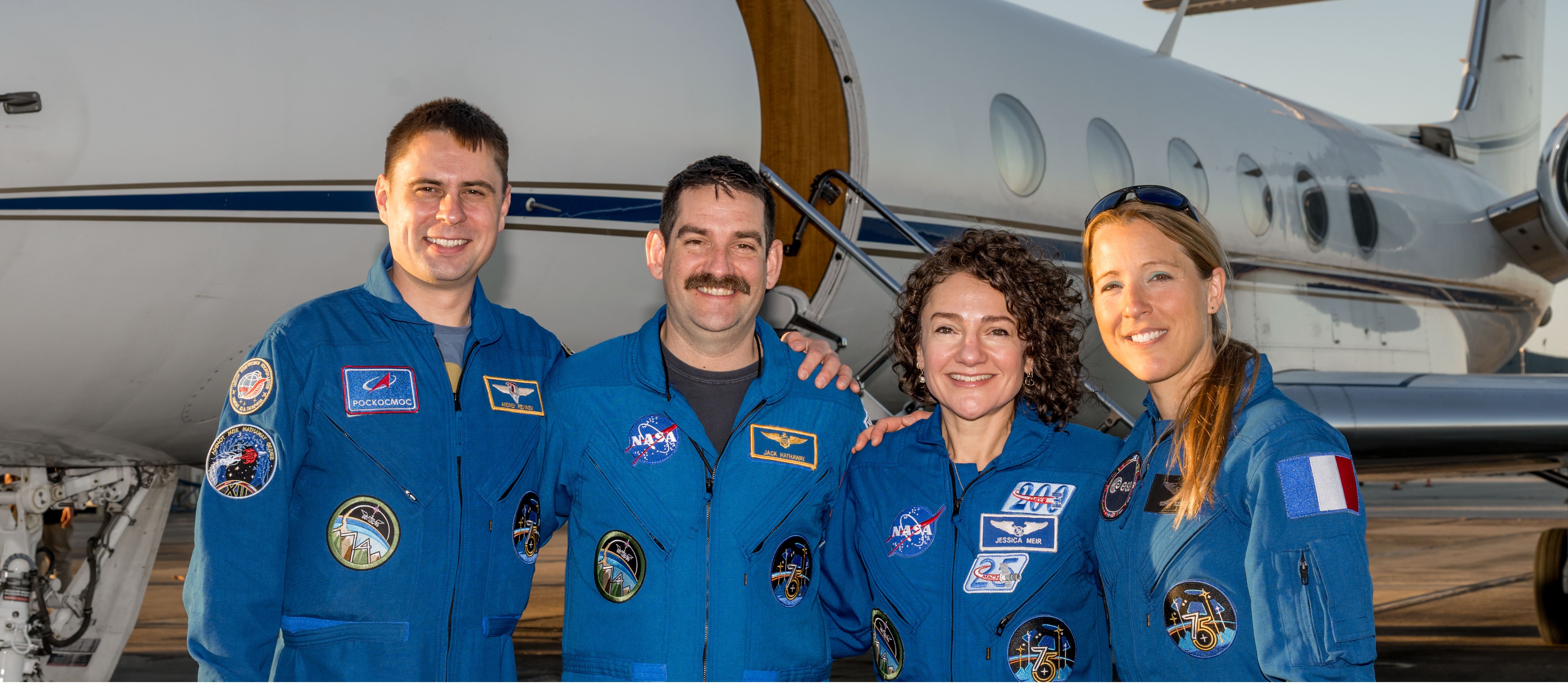
Crew-12
The ISS is currently inhabited by the 3 members of Expedition 74. With the arrival of Crew-12, 4 new residents will join them. This will bring the total crew to 7, returning the ISS to full operational capacity.
Crew-12 consists of Andrey Fedyaev (RUS, mission specialist), Jack Hathaway (US, pilot), Jessica Meir (US, commander), and ESA’s Sophie Adenot (FR, mission specialist). The team has completed their final preparations. Their Falcon 9 rocket with the Crew Dragon capsule is ready for launch. After liftoff, they will dock with the ISS approximately 28.5 hours later.
Sophie Adenot, a driven professional
Sophie Marie Laurence Adenot (born July 5, 1982) is an engineer, helicopter pilot, and colonel in the French Air and Space Force. She studied aerospace engineering, specializing in aerodynamics. She subsequently earned a Master of Science at MIT, where she conducted research on how the human vestibular system adapts to artificial gravity. This research contributed to the development of centrifuge training for astronauts.
Within the French Air Force, Sophie conducted search-and-rescue missions as a helicopter pilot in hostile environments. In 2018, she became France’s first female helicopter test pilot. To date, Sophie has logged over 3,000 flight hours across 22 different helicopter types.
In 2022, Sophie was selected for ESA’s astronaut class from over 22,500 candidates, becoming only the second French woman ever to join the European Astronaut Corps. After 3 years of intensive training, she is now fully prepared for her first spaceflight.

The Epsilon mission
This is Sophie’s first spaceflight. The mission will last approximately 8 months and is named Epsilon. Sophie chose this name herself. In mathematics, ε represents a small but essential quantity. During the mission, the symbol represents the power of individual contributions within a grand, collective project.
The mission patch features 5 stars and a hummingbird. In astronomy, Epsilon is the fifth-brightest star in the constellation Leo. The hummingbird is one of the smallest birds on Earth, yet it plays an indispensable role in ecosystems.
During Epsilon, Sophie will contribute to approximately 200 experiments, many of which are under European leadership. Her research includes human physiology, technology demonstrations and preparations for future missions to the Moon and Mars. A major focus of her mission is human health in space.
The mission also has a strong educational component. One of the experiments, ChlorISS, involves students from more than 4,500 French schools. The students grow seeds on Earth in parallel with experiments aboard the ISS, studying the influence of gravity and light on plant growth.
Sophie views the collaboration with Russian and American colleagues aboard the ISS as a hopeful example for the rest of the world. As she puts it: “Being a French/European astronaut is a great honor that I carry with gratitude and humility. When France and Europe participate in this great, global space adventure, they bring together science, education, technology, economy and diplomacy, as well as the hopes of many people.”
Follow here live as Sophie Adenot begins her historic journey to the International Space Station: an inspiring moment for France, for Europe, and for the future of space exploration.

in je inbox
Op de hoogte blijven van al het ruimtevaart nieuws?
Blijf op de hoogte van alles wat er speelt bij Space Expo. Ontvang het laatste nieuws, ontdek nieuwe tentoonstellingen en krijg als eerste updates over bijzondere activiteiten en evenementen. Zo haal je nog meer uit je volgende bezoek.

.jpg)

